I spent 15 years on federal wildland fire crews, and my feet paid for it. If you've ever tried to jam a wide foot into a standard D-width boot, you know the drill: numbness, blisters, black toenails. The only real fix is buying 4e wide work boots and not settling for a boot that only calls itself wide. This guide covers why width matters, what to look for, and which boots I actually trust on steep ground and hot line.
Why 4E Wide Work Boots Are Not the Same as "Wide"
A lot of guys walk into a boot store, say "I need a wide boot," and walk out with a pair marked 2E. That's a start, but it's not the same as 4E. The width scale runs from A (narrow) up to D (medium), then E, EE, EEE, and 4E. Each step adds roughly a quarter-inch across the ball of the foot. So a 4E boot gives you about half an inch more room than a standard EE. If you have a high-volume foot, a bunion, or just toes that spread when you hike downhill, that extra room is the difference between a boot that works and one that makes you quit.
I remember a sawyer on my crew in Idaho who wore a 2E boot for an entire season. By September, he had a plantar fascia strain and couldn't pull a saw. When he finally got into a real 4E last, he said it felt like taking off a vise. Wide feet don't care about marketing. They care about volume.
Width also affects your knees and back. A too-narrow boot throws off your stride and makes your body work harder than it should.

What to Look For in 4E Wide Work Boots
When you're shopping for 4e wide work boots, don't get distracted by the shiny tag. Here's what actually matters.
Look for a full-grain leather upper that stretches without falling apart. A real shank — steel or composite — keeps the boot rigid on slopes. A lug outsole from Vibram or a solid wedge sole handles the ground you actually work on. Safety toes add heft; pick alloy or composite if you need them. And the toebox has to be wide at the metatarsal, not just at the tip. Some "wide" boots flare at the toe but stay tight at the instep. That doesn't help.
The Field-Tested Lineup (What Actually Works in 4E)
I put three pairs of 4e wide work boots through a full season of digging line, hiking trail, and daily abuse. Here's the honest breakdown.
First is the Dunham Cloud in 4E. Dunham has built wide-fit boots for a long time. The Cloud runs around $170 and has a Vibram sole, waterproof membrane, and a removable insole. I wore it for trail patrol, and the width was the first thing I noticed. My toes actually spread out. But it's not a heavy line boot; the leather is a bit thin and the toe cap scuffs fast. It's good for ranch work or concrete.
Second is a Rocky 4E work boot, priced around $240. Rocky has that domestic work boot heritage, and the wide last is genuinely wide. I used it for cutting line on a brush fire and it held up. The shank is solid, the leather thick, and after 40 hours it stopped needing break-in. It was heavier than the Dunham by nearly a pound, but after two 16-hour shifts my feet didn't feel like hamburger.
Third is a $120 discount boot that claimed 4E. I wore it for two days, then threw it in the burn barrel on purpose. The sole was glued on, the insole collapsed, and the "wide" width measured narrower than my standard D-width Red Wings. This is why you can't trust the label alone.
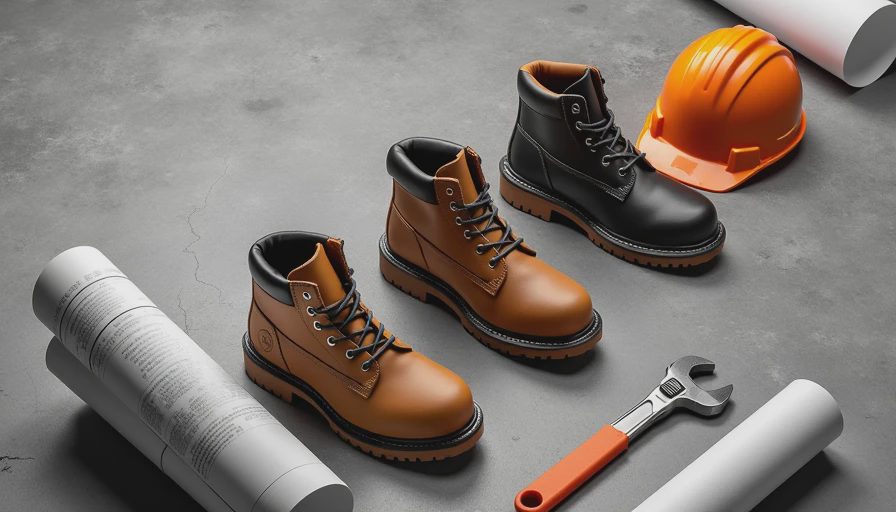
So what do I recommend? If you're on a crew, go with the Rocky. If you're on flat ground all day, the Dunham is a solid value. And if you're standing on concrete, look for a wedge sole and skip the heavy lug.
How to Size Wide Work Boots So They Fit
Sizing is where most guys screw up. You want a thumb's width between your longest toe and the end of the toebox. More important, the widest part of your foot needs to line up with the widest part of the boot. Trace each foot on paper at the end of the day; most people have one foot bigger. Fit the bigger foot.
Try boots on with the same socks you'll wear on the job. Walk up stairs and lean into a slope. If your foot slides forward and jams your toes, the boot is too big even if it feels wide. Your heel should lock in place, and the instep shouldn't cut off circulation.
Don't use your sneaker size as a guide. A boot last is different. Order from a shop that lets you exchange both widths. I've had good luck comparing 2E and 4E side by side. If you're between sizes, go up a half size and add a leather insole. You can always take up volume, but you can't make a boot wider.
My Bottom Line
Most "wide" work boots on the market are 2E, not 4E. If your foot hurts at the ball, or you're blowing out the stitching around your pinky toe, the problem isn't quality. It's the width. The right 4e wide work boots should feel firm but not crushing out of the box, and shouldn't give you new blisters by hour three.
I ignored width for years. Don't make that mistake. Spending an extra $40 to get into a true 4E from a brand that makes a wide last is worth it. Your feet, knees, and back will thank you by October.
Worn in fire. Proven in dirt.